Home/Technologies/Mobile
Mobile app development company
A mobile app development company that picks native or cross-platform to fit your app.
Avaib is a mobile app development company with more than twenty years building iOS and Android apps, in Flutter, React Native, native Swift and native Kotlin. Because we build both native and cross-platform, we choose the approach that fits your app, build the back end behind it too, and publish under your own store accounts, at a cost-effective rate.
Delivered for teams in Australia, the United States, Canada and the Middle East.
One app, two platforms, one big decision
The mobile technology under your app decides its cost, quality and future.
Mobile app development is the building of software for phones and tablets, across iOS and Android, either natively in Swift and Kotlin or cross-platform in a framework like Flutter or React Native that ships one codebase to both stores. See our mobile app development services for the full range of software builds we deliver.
That choice is where the trouble usually starts. Most studios only really do one of these, so they push every client toward it, native-only shops quote you two apps and double the bill, hybrid-only shops force a demanding app into a framework that struggles with it. Either way the approach gets decided before anyone has understood what your app actually needs to do.
Avaib works the other way round. We build both native and cross-platform, so we can recommend the approach that genuinely fits your app, build the back end that makes it work, and, where it helps, add an in-app AI assistant that answers users in plain language. You get code you own on a mainstream foundation you can maintain for years — one of the choices we weigh across the wider technology stack.

Not sure whether your app should be native or cross-platform? That is exactly the question we are set up to answer.
Get a free quoteWhat we build for mobile
iOS and Android apps, and the back end that makes them work.
From cross-platform apps in Flutter and React Native to fully native builds in Swift and Kotlin, plus the server behind the screens and the store publishing around it, here is the range of mobile work our senior specialists build and maintain.
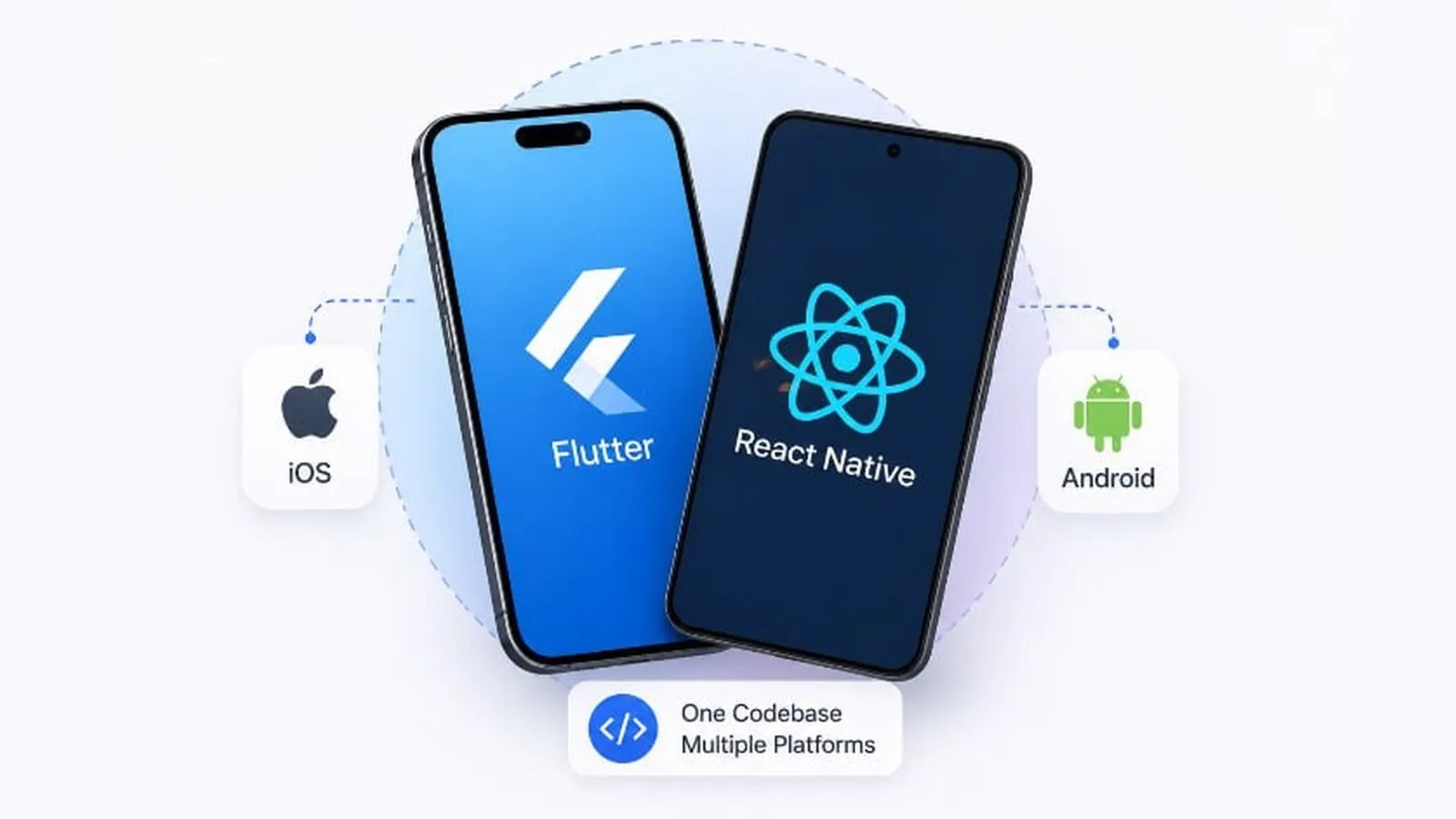
Cross-platform apps in Flutter and React Native
Imagine reaching every customer on both iOS and Android from one codebase, funding a single team instead of two, at close to half the build and maintenance cost, with the same quality on each store.

Fully native apps in Swift and Kotlin
Native iOS in Swift and native Android in Kotlin for the apps that need the last ounce of performance, deep camera, sensor or offline power, and a look that feels native to each platform.

The back end that makes the app work
The API, database, authentication, payments and push notifications behind the screens, so the app your customer taps actually does its job, because a mobile app is only as good as the server it talks to, and that is where half-finished apps come unstuck.

App Store and Play Store publishing
Built to Apple and Google review guidelines and shipped under your own developer accounts, so the app clears review instead of bouncing for weeks, and you own the listing outright.

Offline, real-time and device features
Offline data capture that syncs when signal returns, live updates, GPS, camera and secure on-device storage, the phone-native capabilities a browser tab simply cannot reach.
Rescuing and re-platforming existing apps
Taking a janky hybrid app, an abandoned codebase or an app stuck on an old framework, and moving it onto a steady, supported foundation that passes review and runs on current OS versions.
Not sure which of these fits your app? Tell us what you are building and we will map it out.
Get a free quoteThe native-versus-cross-platform false choice
How the wrong mobile approach gets chosen for you.
This is the most common way a mobile project ends up on the wrong foundation. It is not that native or cross-platform is bad; it is that one of them gets chosen before your app is understood. Everything about how we work is designed to avoid it.
The approach is decided before your app is understood
A native-only shop quotes two separate iOS and Android builds; a hybrid-only shop reaches for one framework for everything. Either way the technology decision is made before anyone has looked properly at what your app has to do.
Your app is bent to fit their default
If they only build native, you pay for two apps and features drift apart between them. If they only build hybrid, a performance-heavy app is forced into a framework that struggles with it. You compromise so their comfort zone wins.
You are left on the wrong foundation
Later the cross-platform app cannot do the one native thing it needed, or the two native apps cost double to keep in step, and changing course means a rebuild. The approach was never chosen for your app in the first place.
Native and cross-platform are both excellent, for different apps. The mistake is treating the choice as a house rule instead of a decision made for your app, its features, your budget and where it needs to go next.
The decision map
When native wins, when cross-platform wins.
There is no single best mobile technology, only the best fit for your app. Here is roughly how the decision falls, and how we make it with you rather than for you.
- The app leans hard on the camera, sensors, AR or heavy graphics and needs every bit of platform performance.
- It is a single-platform product to start with, so there is no second store to justify sharing a codebase.
- It must feel and behave exactly like a first-party iOS or Android app, down to the smallest platform detail.
- It depends on the newest OS features the moment Apple or Google ships them.
- You need to be on both iOS and Android, and the app is mostly screens, forms, data and standard flows.
- Budget and speed matter, and one codebase for both stores means you build and maintain one app instead of two, so more of your money goes into features, not duplication.
- You want iOS and Android to stay identical, with features and fixes landing on both at the same time.
- It is an MVP or a fast-moving product where shipping to both platforms quickly is worth more than squeezing out the last few per cent of native performance.
Want a straight recommendation on native versus cross-platform for your app? Tell us what it has to do.
Get a free quoteThe concerns, answered
What worries people about a mobile build, and how we handle it.
These are the real concerns we hear before a mobile project or an app rescue starts. Here is exactly how Avaib takes each one off the table.
Why Avaib
Why choose Avaib as your mobile app development company.
Plenty of studios can build an app in their one preferred way. Fewer pair two decades of shipping to both stores with senior specialists in both native and cross-platform, a real QA department, and a price that does not punish you for the quality.
20+ years across native and cross-platform
Building mobile since 2004, across more than 600 projects, in Flutter, React Native, native Swift and native Kotlin, so we can recommend and build whichever approach genuinely fits your app.
The approach chosen for your app, not our default
We build both native and cross-platform, so we have nothing to defend. We recommend the one that fits your app, budget and roadmap, and explain the trade-offs in plain language.
The whole app, back end included
Senior people own the screens, the API, the data, the payments and the push notifications as one connected product, backed by a dedicated QA department that tests on real iPhones and Android devices, and a 30-day warranty.
Senior expertise, without the premium price tag
The same capability Australian, US, Canadian and Middle-East firms charge a fortune for, delivered by senior mobile engineers from around USD 25 per hour.
AI-accelerated delivery
Our senior mobile engineers use advanced AI coding tools to move through the build faster, steering and reviewing every line, so your app ships sooner without cutting corners on quality.
You own the app and the store accounts
The code, the data and the documentation stay yours, and the app is published under your own Apple and Google developer accounts, so you are never locked out of your own product.
Want a senior mobile team that picks the right approach and hands you the app, without the enterprise price tag?
Get a free quoteHow we work
From first conversation to an app that lasts on both stores.
Understand the app first, recommend the right approach and agree a clear scope, build the app and its back end together in tested slices on real devices, then publish and keep it current, so you always see progress and never end up on the wrong foundation.
Understand the app and who uses it
We start with what the app has to do, which platforms it needs to be on, and the native features it depends on, so the native-versus-cross-platform decision is made to fit your app rather than our habit.
Recommend the right approach, and agree the scope
You get an honest recommendation, native, cross-platform, or a mix, with the trade-offs in plain language, plus a clear scope so you know what will be built, in what order, and what it will cost before development begins.
Build the app and its back end, tested on real devices
Senior specialists build the app and the server behind it as one product, each slice tested by our QA department on a rack of real iPhones and Android phones, so you see working software early and it does not crash on the device your customer holds.
Publish, support and keep it current
We take the app cleanly through App Store and Play Store review under your own accounts, back it with a 30-day warranty, and keep it working as iOS and Android change, so it stays fast and store-compliant rather than breaking on the next OS update.
Pricing
Enterprise-grade mobile, without the enterprise price tag.
The same capability Australian, US, Canadian and Middle-East firms charge a fortune for, delivered by senior mobile engineers from around USD 25 per hour, at a fraction of the price. Choosing cross-platform where it fits is often the single biggest saving, since you fund one codebase instead of two. We scope the work clearly up front so you get a fixed, plain-language quote, and every engagement leaves you owning your code, data and store accounts outright.
Fixed-scope mobile app
For a clearly scoped app, we agree the approach, the scope and the price up front, then design, build and test it against your real requirements across the stores you need.
Dedicated mobile team
A senior mobile team fluent in Flutter, React Native, Swift and Kotlin, working as an extension of yours, that you can scale up or down as priorities shift while the knowledge stays with people who stay on your app.
App rescue or re-platform
We take on a janky, abandoned or wrong-framework app, then stabilise, re-platform or modernise it on a plan sized to your risk and budget, and get it back through store review.
Every project is delivered by senior mobile specialists under one accountable team, tested by a dedicated QA department on real iPhones and Android devices, backed by a 30-day warranty, and you keep the code, data and store accounts with no lock-in. Not sure whether to build native or cross-platform? We will give you an honest recommendation on a free scoping call and send you a free, no-obligation written estimate with a clear scope.
Want a clear read on your mobile app and what it should cost?
Get a free quoteTell us about your app and we will recommend native or cross-platform.
Whether it is a new app, a rescue, or a build you are not sure how to approach, get an honest read, a clear scope and a ballpark price, free and with no obligation.
Get a free quoteWho we help
Mobile expertise for teams that need the right app, built the right way.
If you are shipping a first app, told to rebuild native, paying for two codebases, or stuck on a niche framework, here is the kind of team Avaib fits, and the problem we usually solve for each.
The mobile toolbox
The frameworks, languages and store tooling we work in.
Deep across both cross-platform frameworks and native iOS and Android, and fluent with the back-end, payments, device and store tooling around them, so your app fits cleanly with what you already run and ships reliably.
In our clients' words
Relationships that last years, not projects.
Rated 4.5/5 on Google and 5/5 across other platforms, with 10+ written references and 80%+ client retention.
"I have nothing but positive things to say about Avaib. We have dealt with his company as our sole software providers for over 18 years now with very few issues. I would recommend their services anytime."
"As a senior product manager, I have worked with a handful of vendors, consultant agencies and development shops. I am confident to say that Avaib is among the best considering the velocity, quality of the work and the overall ROI. The team took ownership, overcame a steep learning curve in a new industry, and delivered promises. We are very thankful for the dedication of the team and would recommend Avaib to any company, large or small, to help with your technical project."
"We partnered with Avaib for custom software, mobile app, and web design & development projects, and the experience was excellent. All solutions were robust, well-structured, and delivered on time. They added real value to our clients' businesses."
Common questions
Mobile app development, answered.
What is a mobile app development company?
A mobile app development company designs, builds, tests and publishes applications that run on smartphones and tablets, across iOS (Apple) and Android (Google). That covers the app itself, the screens people tap, and the back end behind it: the server, database, authentication, payments and push notifications that make the app actually work. It also usually includes getting the app through App Store and Google Play review and keeping it running as the operating systems change.
Mobile apps are built either natively, in Swift for iOS and Kotlin for Android, or cross-platform, in a framework like Flutter or React Native where one codebase ships to both stores. A good mobile app development company chooses the approach that fits your app rather than defaulting to one. Avaib has built mobile software since 2004, across more than 600 projects, with senior specialists in both native and cross-platform development.
Should we build native or cross-platform?
It depends on your app. Cross-platform, using Flutter or React Native, is usually the right call when you need to be on both iOS and Android and the app is mostly screens, forms, data and standard flows, because one codebase keeps build and maintenance cost close to half and keeps both stores identical. It is ideal for MVPs and fast-moving products.
Native, using Swift and Kotlin, is the better choice when the app leans hard on the camera, sensors, AR or heavy graphics, needs every bit of platform performance, or must adopt brand-new OS features the day they ship. Because we build both, we recommend the approach that fits your app, and sometimes that is a mix, rather than pushing whichever one we happen to sell.
Which mobile technologies does Avaib build with?
For cross-platform work we build in Flutter (Dart) and React Native, shipping a single codebase to both iOS and Android. For native work we build iOS in Swift and SwiftUI and Android in Kotlin and Jetpack Compose, for the apps that need maximum platform performance and the newest OS features.
Around the app we build the back end it depends on, the API, database, authentication, payments and push notifications, and we work with the store tooling (App Store Connect, Google Play Console) and CI-CD to ship and update reliably. Everything is tested on real iPhones and Android devices by a dedicated QA department.
Can you rescue or re-platform an app we already have?
Yes, and it is one of the most common jobs we are called in for. Whether the app is a janky hybrid build, an abandoned codebase, or stuck on an old framework nobody can maintain, we start with an honest assessment of its real state rather than reaching straight for a rebuild.
From there we stabilise it, fix what is failing, and where it makes sense re-platform it onto a steady, supported foundation, then get it back cleanly through App Store and Play Store review and up to current OS versions. A full rewrite is a last resort, not our opening offer.
Do you build the back end too, or only the app itself?
Both, and this is where a lot of mobile projects come unstuck. An app is only as good as the server it talks to, so we build the API, the database, the authentication, the payments and the push notifications as one connected product with the app, by senior people who own the whole picture.
That means the business logic and integrations are handled properly, not left half-built, so what you get is a complete, working application rather than attractive screens with nothing behind them.
How much does mobile app development cost?
It depends on the scope and the approach, since a cross-platform MVP is very different from a pair of fully native apps with heavy back-end and device features. That is why we scope the work clearly up front and give you a fixed, plain-language quote before any development starts, so there are no open-ended surprises. Choosing cross-platform where it fits is often the single biggest cost saving, because you fund one codebase instead of two.
Our senior mobile engineers work at a cost-effective rate of around USD 25 per hour, the same capability Australian, US, Canadian and Middle-East firms charge a fortune for, and AI-accelerated delivery helps get you there faster. After a short conversation we will send you a free, no-obligation written estimate with a clear scope.
Will we own the app, or be locked in?
You own everything. We hand you the full source code, the data and the documentation in mainstream, well-supported mobile technology any capable team can maintain, and we publish the app under your own Apple and Google developer accounts. There is no lock-in to us and no dependence on a single developer, and you can never be shut out of your own product.
We deliberately avoid niche frameworks and undocumented structures that only we can run. You stay with Avaib because the work keeps delivering value, not because you are trapped.
Got a question that isn't here? Ask it on the quote form, we answer every one.
Get a free quoteExplore more
Related technologies.
Explore the rest of our technologies — and the hub they all connect to.
AI & Machine Learning
The models and tooling behind practical AI features, chosen to fit your product.
Learn more →Cloud
Cloud-native foundations you can scale, from infrastructure to deployment.
Learn more →Microsoft / .NET
C#, ASP.NET, Azure and the wider Microsoft stack for enterprise-grade business systems.
Learn more →JavaScript Development
Full-stack JavaScript — React, Node and the modern web.
Learn more →PHP & Laravel Development
Fast, proven web and SaaS builds on Laravel's foundations.
Learn more →Python Development
The language most data-heavy and AI work is built in, for applications and APIs.
Learn more →Software Development Technology Stack
The full range of technologies our senior specialists build with, chosen to fit your project.
Learn more →Let's build your app the right way, native or cross-platform.
Book a free consultation. No jargon, just an honest read on the best approach for your app and a clear path to get there.
Get a free quote